If you’re searching for clear, up-to-date information about a PA medical marijuana card, you’re likely trying to answer one simple question: How do I legally access medical cannabis in Pennsylvania—and is it worth it?
This guide is written to give you a complete, practical understanding of Pennsylvania’s Medical Marijuana Program as it stands in 2025–2026, without confusion or filler.
Whether you’re a first-time patient, a caregiver, or someone renewing a card, you’ll find everything you need to know in one place.
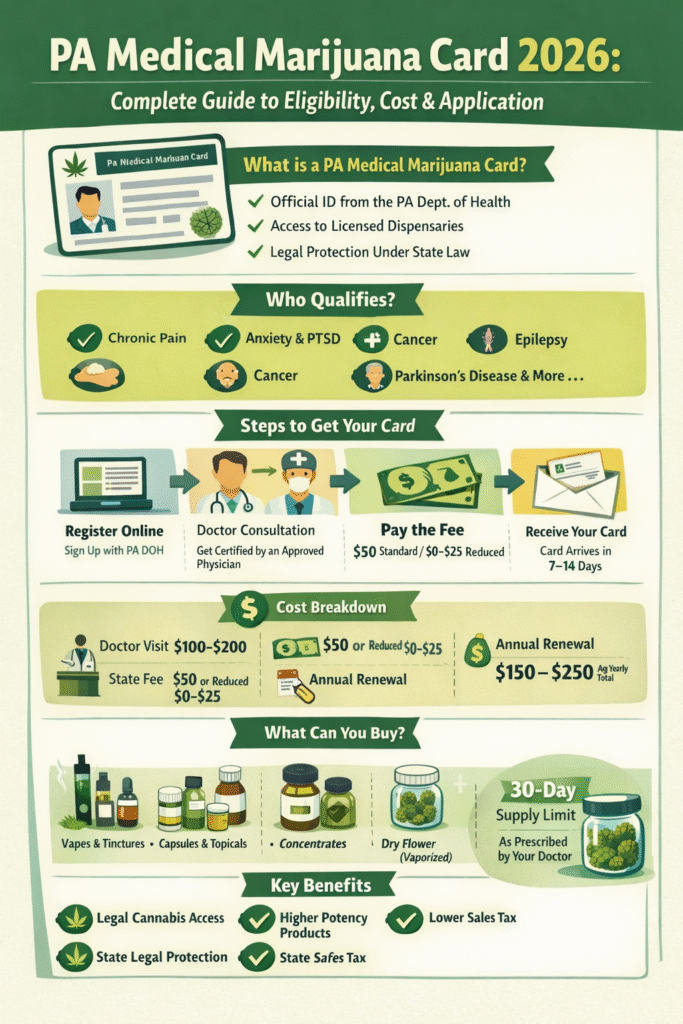
What Is a PA Medical Marijuana Card?
A PA medical marijuana card is an official identification card issued by the Pennsylvania Department of Health (DOH). It allows qualifying patients to legally purchase, possess, and use medical cannabis from state-licensed dispensaries.
Pennsylvania operates a regulated medical-only cannabis program, meaning recreational marijuana is still illegal. Without a valid card, possession remains a criminal offense.
The card serves three purposes:
- Verifies you are a registered medical marijuana patient
- Grants access to licensed dispensaries across Pennsylvania
- Protects you under state medical marijuana laws
Who Qualifies for a PA Medical Marijuana Card in 2025–2026?
Eligibility is based on qualifying medical conditions approved by the Pennsylvania Department of Health. The list has expanded over the years and continues to reflect modern medical research.
Approved Medical Conditions
You may qualify if you have been diagnosed with one or more of the following:
- Chronic pain (one of the most common qualifying conditions)
- Anxiety disorders
- PTSD (post-traumatic stress disorder)
- Cancer
- Multiple sclerosis
- Epilepsy or seizure disorders
- Crohn’s disease
- Autism spectrum disorder
- Parkinson’s disease
- HIV/AIDS
- Neuropathies
- Severe migraines
- Opioid use disorder (as part of a treatment plan)
Important note: You do not need to be terminally ill, and many patients qualify for anxiety or chronic pain alone.
How to Get a PA Medical Marijuana Card (Step-by-Step)
The process is straightforward when done correctly. Most patients complete it in a few days.
Step 1: Register With the Pennsylvania DOH
Create an account on the Pennsylvania Medical Marijuana Registry. You’ll need:
- A valid Pennsylvania ID or driver’s license
- An active email address
- Basic personal information
Make sure your name and address exactly match your ID.
Step 2: Get Certified by an Approved Physician
You must be evaluated by a DOH-approved medical marijuana physician. This can be done:
- In person
- Via telemedicine (widely accepted in 2025–2026)
The doctor reviews your medical history and confirms whether you meet the eligibility criteria. No invasive exams are required.
Step 3: Pay the State Fee
After physician certification, you pay the state registration fee:
- Standard fee: $50
- Reduced fee: $0–$25 (for Medicaid, SNAP, SSI, WIC recipients)
Step 4: Receive Your Card
Once approved, your PA medical marijuana card is mailed to you. Delivery usually takes 7–14 days.
How Much Does a PA Medical Marijuana Card Cost?
Here’s a realistic cost breakdown for 2025–2026:
| Item | Cost |
| Doctor certification | $100–$200 |
| State registration fee | $50 (or reduced) |
| Annual renewal | Similar to initial cost |
Average total cost: $150–$250 per year
There are no hidden fees beyond renewal.
What Can You Buy With a PA Medical Marijuana Card?
Pennsylvania allows medical cannabis only, with specific product types approved.
Allowed Forms of Medical Marijuana
- Vape cartridges
- Tinctures
- Capsules
- Topicals
- Concentrates
- Dry flower (approved for vaporization only)
Smoking is still prohibited, but vaporizing dry flower is legal.
How Much Cannabis Can You Legally Possess in PA?
Pennsylvania uses a 30-day supply limit, determined by your physician. There’s no fixed ounce limit, which gives doctors flexibility based on medical need.
Dispensaries track purchases electronically to ensure compliance.
Benefits of Having a PA Medical Marijuana Card
Holding a valid card provides more than legal protection.
Key Advantages
- Legal access to tested, regulated cannabis
- Higher potency options than CBD-only products
- Lower sales tax compared to recreational states
- Protection from prosecution under state law
- Ability to consult dispensary pharmacists
For many patients, medical cannabis also reduces reliance on opioids, sleep medications, or anxiety prescriptions.
Caregivers and Minors: Special Rules
Caregivers
Patients can designate up to two caregivers, who must:
- Be 21 or older
- Pass a background check
- Register separately with the DOH
Minors
Patients under 18 require:
- A parent or legal guardian as caregiver
- Physician approval
- Limited product recommendations
Renewal Process: What Patients Often Get Wrong
Your PA medical marijuana card is valid for one year.
Common Renewal Mistakes
- Waiting until the card expires
- Forgetting physician recertification
- Not updating address or ID details
- Assuming auto-renewal (it doesn’t exist)
Best practice: Start renewal 30–45 days before expiration.
Best Practices for New PA Medical Marijuana Patients
- Start with low doses and adjust gradually
- Consult the dispensary pharmacist (they are licensed professionals)
- Track strains and products that work best for your condition
- Avoid driving or operating machinery while medicated
- Store products securely, especially around children
Legal Considerations You Should Know
Even with a card, there are limits.
- Cannabis remains illegal under federal law
- You cannot transport marijuana across state lines
- Employers may still enforce drug-free workplace policies
- Driving under the influence is strictly prohibited
Understanding these boundaries protects your card status.
Frequently Asked Questions (FAQ)
How long does it take to get a PA medical marijuana card?
Most patients receive their card within 7–14 days after completing certification and payment.
Can I get a PA medical marijuana card for anxiety?
Yes. Anxiety disorders are one of the most common qualifying conditions in Pennsylvania.
Is telemedicine allowed for PA medical marijuana evaluations?
Yes. Telehealth evaluations are widely accepted and commonly used in 2025–2026.
Does insurance cover medical marijuana in PA?
No. Insurance does not cover cannabis or certification fees.
Can I use my PA medical marijuana card in another state?
Only in states with medical marijuana reciprocity, and rules vary. Pennsylvania cards are not universally accepted.
Can my employer fire me for medical marijuana use?
Possibly. Pennsylvania law does not fully protect employees from workplace drug policies.
How much marijuana can I buy at one time?
Purchases are limited to a 30-day supply, as determined by your physician.
Do I need medical records to qualify?
Not always. Many physicians can certify based on consultation and prior diagnosis discussion.
Final Thoughts: Is a PA Medical Marijuana Card Worth It?
For patients dealing with chronic pain, anxiety, PTSD, or neurological conditions, a PA medical marijuana card offers legal access to carefully regulated treatment options that many find life-changing.
The application process is manageable, costs are predictable, and legal protections make it a smart choice for qualifying residents.
When used responsibly and under medical guidance, Pennsylvania’s program continues to be one of the more patient-friendly systems in the U.S.
If your condition qualifies, getting a card isn’t just legal compliance—it’s access to care.